

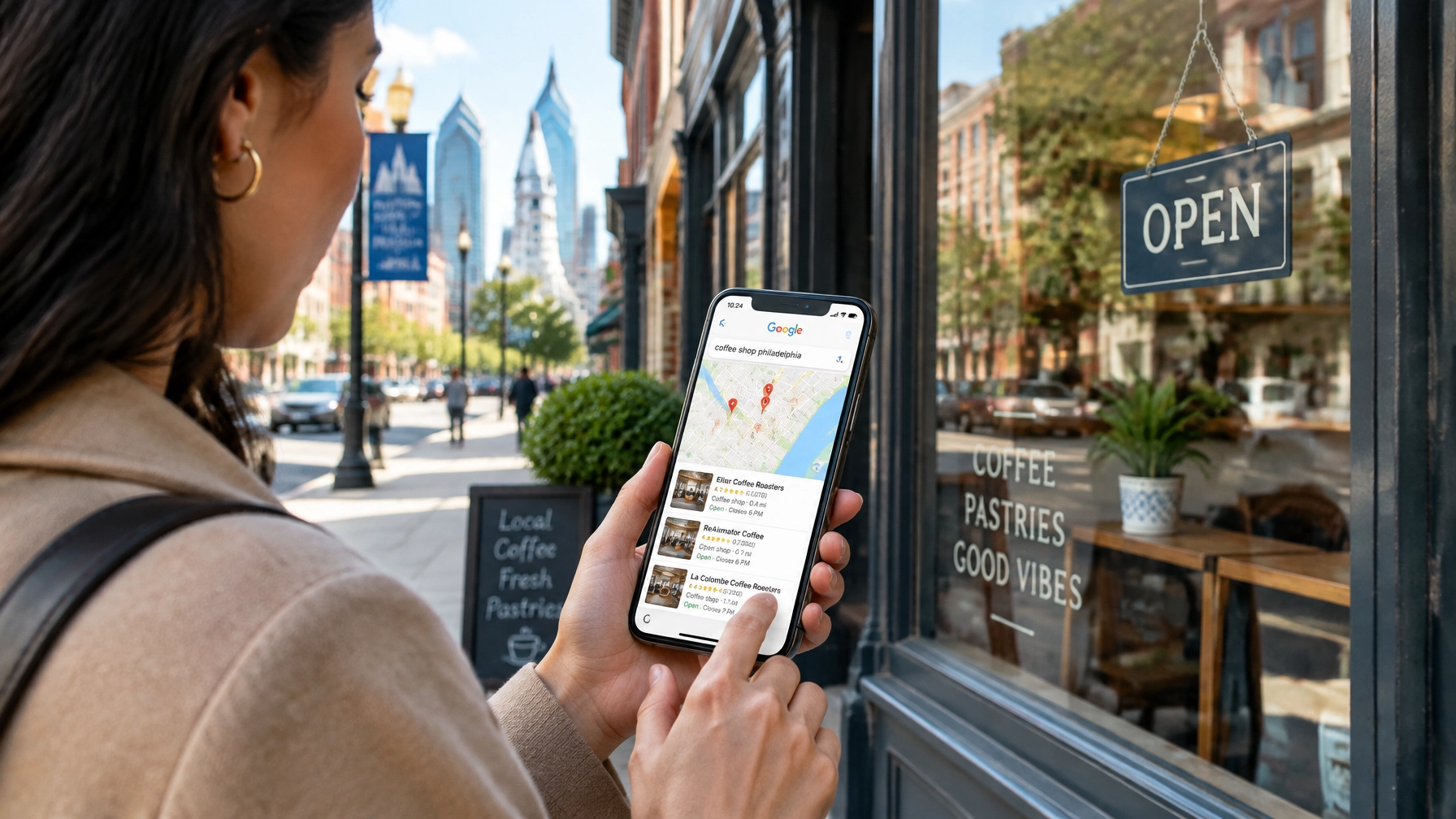
LOCAL SEARCH STARTS HERE
Help More Philadelphia Customers Find Your Business
When someone searches “bakery near me,” “Philadelphia roofer,” or “web designer in Fishtown,” Google has to decide which businesses deserve attention first. Local SEO helps your business appear in those searches, especially when customers are ready to call, visit, book, or buy.
The good news? You don’t need to master every SEO tool to build a strong foundation. Start with accurate business information, a complete Google Business Profile, consistent listings, helpful reviews, and a fast website that clearly explains what you offer.
This beginner-friendly guide walks you through the essentials.
UNDERSTAND THE LOCAL SEO BASICS
Local SEO connects your business with nearby customers
Local SEO is the process of improving your online presence so people in your service area can find you through Google Search and Google Maps.
It matters for businesses with a physical location, service-area businesses, and local brands that serve customers in specific communities. A South Philadelphia contractor, a Center City law firm, and a Manayunk wellness studio all need strong local signals, but each business should tailor those signals to its services and audience.
Google generally evaluates local results through three primary factors:
- Relevance: How closely your business matches the search.
- Distance: How close your business is to the searcher or location searched.
- Prominence: How established and trusted your business appears online.
You can’t control every factor, especially distance. You can control how clearly you present your business and how consistently you build trust across the web.
OPTIMIZE YOUR GOOGLE BUSINESS PROFILE
Make your business easy for Google to understand
Your Google Business Profile is one of the most important tools in a local SEO strategy. It can appear in Google Search, Google Maps, and local search features before a customer even visits your website.
If you haven’t claimed your profile, start with Google’s official Business Profile guidance. Then complete every relevant section with accurate information.
Your profile should include:
- Your real business name
- Your correct address or service area
- A local phone number
- Your website address
- Accurate opening hours
- A primary business category
- Relevant secondary categories
- A clear business description
- Your services or products
- Current business photos
- Attributes that apply to your business
Choose your primary category carefully. It should describe what your business is, not every service you provide. For example, a restaurant should select the category that best represents its main operation instead of choosing a broad category such as “business.”
Your description should explain what you do, who you serve, and where you operate. Keep the language natural. Don’t fill the description with repeated keywords or add locations you do not genuinely serve.
Update your hours for holidays, special events, and temporary closures. Add new photos when your team, storefront, products, or services change. You can also use Google posts to share announcements, promotions, events, and useful updates.
Start today: Open your profile and check whether every important field is complete and current.
BUILD CONSISTENT LOCAL CITATIONS
Keep your business details identical everywhere
A local citation is a mention of your business on another website or directory. Common examples include Yelp, Apple Maps, Bing Places, Facebook, industry directories, and local business organizations.
These listings help customers discover you and help Google connect information about your business across the web.
The most important details are often called NAP:
- Name
- Address
- Phone number
Your NAP should match across your Google Business Profile, website, social media profiles, and directory listings. Even small inconsistencies can create confusion. For example, avoid using one phone number on your website and another on your directory profiles unless there is a clear business reason.
Review your most important listings first. Correct outdated addresses, old phone numbers, duplicate profiles, and incorrect business categories. If your business moved, changed its name, or updated its service area, make sure those changes appear across your online presence.
You don’t need to submit your business to every directory on the internet. Focus on trusted platforms, relevant industry websites, and legitimate Philadelphia community listings.

USE ON-PAGE SEO TO SHOW YOUR LOCAL RELEVANCE
Tell visitors and search engines exactly what you offer
Your website should make three things clear within seconds:
- What your business does
- Who your business serves
- Where your business operates
Start with your most important pages: the homepage, service pages, contact page, and about page.
Use clear page titles and headings that describe the service and location when appropriate. A local service page might use a heading such as “Residential Roofing Services in Philadelphia” instead of a vague headline such as “Our Solutions.”
You can also improve your on-page foundation by:
- Writing a unique title tag for each important page
- Creating useful meta descriptions
- Using one clear H1 heading per page
- Adding descriptive image alt text
- Linking related pages together
- Including your business name, address, and phone number
- Mentioning the areas you genuinely serve
- Adding clear calls to action
Use Philadelphia neighborhood names only when they are relevant to your actual service area. A page that naturally explains your work in Fishtown, South Philly, or Center City can help customers understand your reach. A page that lists neighborhoods without useful information feels forced and provides little value.
Avoid creating nearly identical pages for every neighborhood. Each location page should offer unique, helpful information about the customers, services, and needs in that area.
EARN REVIEWS AND RESPOND PROFESSIONALLY
Let real customer experiences strengthen your presence
Reviews influence how customers view your business and contribute to your overall local presence. A business with recent, genuine reviews often feels more trustworthy than one with little or no customer feedback.
Ask satisfied customers for reviews after a successful project, purchase, appointment, or service. Make the process easy by sharing your Google review link through a follow-up email, text message, receipt, or personal conversation.
Do not offer rewards in exchange for positive reviews. Instead, invite customers to share an honest experience.
When reviews arrive, respond consistently:
- Thank customers for positive feedback.
- Address specific details when appropriate.
- Respond calmly to negative reviews.
- Avoid arguing or sharing private information.
- Invite complex concerns into a direct conversation.
A thoughtful response shows potential customers that you pay attention after the sale, not only before it.
Reviews should reflect real customer experiences. Never write fake reviews, ask employees to pose as customers, or pressure people to use specific wording.
MAKE YOUR WEBSITE FAST, MOBILE-FRIENDLY, AND USEFUL
Give local visitors a smooth next step
Local search often happens on a phone. Someone might be standing outside a store, comparing service providers between appointments, or searching for help while traveling through Philadelphia.
Your website needs to work well in that moment.
A fast, well-built website supports local marketing because it helps visitors stay engaged after they click from Google. It also makes important information easier to access.
Check whether a customer can quickly:
- Understand your main offer
- Find your service area
- Tap to call your business
- Request a quote or appointment
- See your hours
- Find your address or directions
- Read your content comfortably on a phone
- Navigate between service pages
Large images, unnecessary scripts, complex animations, and outdated website tools can slow down a page. Review your site with Google PageSpeed Insights to identify performance issues.
Speed is only one part of a strong website. Clear navigation, readable text, accessible design, secure development, and focused calls to action matter too.
If your site needs more than a few adjustments, investing in philadelphia web design can help you build a stronger foundation for both search visibility and customer conversions. A professional website should support your local marketing plan, not make customers work to understand your business.

CREATE LOCAL CONTENT THAT HELPS PEOPLE
Answer the questions your customers are already asking
Local content does not need to be complicated. Focus on practical questions related to your services, customers, and community.
For example:
- How should Philadelphia homeowners prepare for a seasonal roof inspection?
- What should a local restaurant include on its online ordering page?
- How can a new business choose the right branding for a Philly audience?
- What should customers ask before hiring a local contractor?
- Which services do you provide in nearby neighborhoods?
Useful content gives you more opportunities to explain your expertise and link visitors to relevant service pages. It also helps your website stay active and informative.
Keep the focus on the customer. Don’t write a page only to repeat “Philadelphia” dozens of times. Explain the problem, provide a useful answer, and make the next step clear.
Local partnerships can also support your visibility. Consider working with complementary businesses, community organizations, local publications, or professional groups. Genuine local mentions and links can strengthen your reputation over time.
FOLLOW A SIMPLE LOCAL SEO ROUTINE
Small, consistent actions create a stronger foundation
Local SEO works best as an ongoing business habit rather than a one-time setup.
Use this simple monthly checklist:
- Review your Google Business Profile hours and services.
- Add a current photo, update, or announcement.
- Check your main business listings for NAP consistency.
- Respond to new reviews.
- Test your website on a mobile phone.
- Review your contact forms and click-to-call buttons.
- Update outdated service information.
- Publish one useful local article or customer resource.
- Check important pages for broken links or confusing content.
You don’t need to change everything at once. Start with the areas that affect customers most: your Google profile, contact information, reviews, and website experience.
BUILD A STRONGER PHILLY SEARCH PRESENCE
Turn local visibility into meaningful action
Local SEO is not about chasing a guaranteed position on Google. It is about making your business accurate, relevant, trustworthy, and easy to contact.
A complete Google Business Profile helps people discover you. Consistent citations reinforce your information. Reviews build confidence. Helpful website content answers questions. A fast, secure website gives visitors a clear path from search to action.
If you’re not sure where to begin, a digital marketing agency philadelphia businesses trust can help you create a practical plan around your goals, audience, and service area.
Vanessa Collado provides personalized web design, website development, branding, and digital marketing support for Philadelphia businesses and growing brands. Whether you need a focused local SEO foundation or small business web design philadelphia customers can navigate with ease, the right improvements can make your online presence clearer and more useful.
Explore Vanessa Collado’s web and digital services or contact Vanessa Collado to discuss your next step.